This e-mail address is being protected from spam bots, you need JavaScript enabled to view it
Frequently Asked Questions PDF

What is Call Center Designer?

What is SimACD?

What is AgentTime? 

How do these products work together?

What is the difference between Call Center Designer and SimACD?

What kinds of call centers use the AgentTime Scheduler?

What is your Workforce Management Software update policy?

What kind of technical support do you provide?

Do you have a demo version of your Workforce Management Software?

How do your Workforce Managment Products compare... 


What is Call Center Designer?

Call Center Designer is a powerful tool designed for call center managers to determine efficient staffing levels for each period of time throughout their workday.  It uses the well known Erlang-C formula.

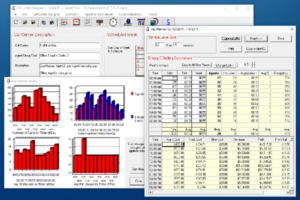
In the Day Planner module, the User enters in the start and end times of their work day, the service level they want to maintain, and the call volumes with average talk and wrap-up times for each time period throughout the day.   The optimum agent and inbound line levels are then calculated along with performance predictions on queue times and agent performance.

In the Staffing module the user can see what the queue performance, service level, and agent occupancy will be for agent levels around the optimum.  This module plots number of agents against such performance values as average speed to answer, queue length, agent occupancy and other predicted values.  The critical break-off points where service levels become unacceptable can be established for the busy hour, least busy hour or average hour of the workday.

Top

What is SimACD?

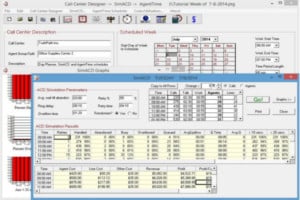
SimACD is an add-on module to Call Center Designer.  You test and try out different numbers of agents and trunks in a computer simulated automatic call distributor (ACD) before actually implementing them in your call center.

Enter or download expected call volumes with the number of agents and trunks you plan on using for each time period in your workday, along with the abandon and re-try behavior of your callers, and the ring delay and overflow characteristics of your ACD.  SimACD then simulates the call arrivals and displays how many calls were queued for how long, overflowed, blocked and received a busy, how quickly they were answered, and other service level results.

The simulation algorithm corrects the well known defects of Erlang-C type formulas, and can be used to refine the output of Call Center Designer by accurately taking into account caller abandonment, re-try, overflow, ACD ring delay, and correct probability distributions of talk and queue times.

 Top

What is AgentTime?

AgentTime is our affordable new agent scheduling solution designed specifically for small and medium sized call centers.

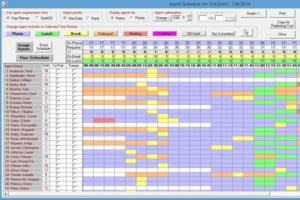
AgentTime creates agent employee schedules from a database of agents, shift definitions, agent availabilities, agent preferences and agent priorities entered by the call center manager. It uses the agent level requirements for each time period in a call center's workweek determined by Portage's current Call Center Designer and SimACD staffing software.  It includes, and is tightly integerated with these products.

An intuitive user interface allows the call center manager to create optimum weekly schedules, and to easily modify them based on personal knowledge and ongoing day-to-day changes in operations. A key goal in the design of AgentTime has been to make sure the user is not locked into blindly accepting any given schedule created by the system. They can modify shifts and activities such as breaks, lunches, meetings, and training periods on the fly to immediately see the effects on required vs. scheduled agents for all time periods of the workday.

Version 4.0 now has our new Flex-Shift™ technology that makes a second optimizing pass through the schedule to make them even more closely match the call center;s agent requirements.

Pricing for AgentTime is $4,900.00 to $9,900.00 depending on the number of agents to be scheduled.

 Top

How do these products work together? 

Image 

What is the difference between Call Center Designer and SimACD?

Simply stated, Call Center Designer tells you the number of agents needed to reach your desired service levels, whereas you tell SimACD the number of agents you want to use and you then see what service levels result.

Call Center Designer uses statistical methods (the well-known Erlang formulas) to calculate optimum staffing levels and call center performance data based on call volumes and services levels that you enter.  SimACD uses random number generation techniques to simulate the minute to minute operation of an ACD and presents what will happen with various agent and inbound line combinations.  Call Center Designer is used to obtain baseline agent levels, then if needed, SimACD is used to refine these values by accurately taking into account caller abandonment and retrial behavior, ACD overflow, ring delay, and a more accurate modeling of call lengths and queue duration.

We are convinced that these two products combined provide the most comprehensive agent staffing analysis and call center performance prediction software available today.  For some good background information on staffing methods, read our white paper: A Primer on Call Center Staffing .

Both products also do financial calculations based on expense and revenue data you have entered.   You will see the profit per call, inbound line and agent costs, etc.  You can also determine what agent levels are best for profit as opposed to the service level you provide to callers.

 Top

What kinds of call centers use the AgentTime Scheduler?
 
We primarily sell to small and medium sized call centers that have between 10 and 80 or so agents.  Usually these call centers cannot afford the "full-blown" workforce management systems that sell for $25,000.00 to $200,000.00.  They use our products for staffing analysis and scheduling to accurately seat the right number of agents at the right times.  Inaccurate staffing is actually more harmful the smaller the call center is since the addition or subtraction of just one or two agents can have dramatic effects on call center productivity with agent groups of less than 50 agents.  (Again, see our white paper: A Primer on Call Center Staffing.)

Many large call centers also use our products for in-depth staffing analysis to supplement their workforce management and scheduling systems.  Rather than just accepting the static calculations these systems  tell them, they use Call Center Designer and SimACD to "play with the numbers" and do "what-if" analysis to show them how to improve their operations and what the effects of different call patterns and agent arrangements will have on customer service and call center costs.

Our AgentTime scheduler is more flexible than the competition as well. It allows users to change the calculated schedules on the fly to reflect their personal knowledge and situations that cannot be programmed into a scheduling algorithm. It doesn't force the user to accept schedules that they might deem unreasonable.

 Top

What is your Workforce Management Software update policy?

Whenever a new version of our products is released, we notify our installed customers and provide a free update via email or disk if there has been no price change. If a new version entails an increase in the price of our products, current users will get a significant price break.  There are no ongoing subscription fees and so far new version updates have all been free.

 Top

What kind of technical support do you provide?

Free telephone support is given 8:00am to 5:00pm PST Monday through Friday.  Sometimes you may need to leave a message, but you will always get a call back the same day.  We  can also schedule free over-the-phone training sessions using our demo data files, or with your own call volume and scheduling data.

 Top

Do you have a demo version of your Workforce Management Software?

We have a product demonstration CD. Call us at 1-888-844-5320 or 208-263-6776 to receive a free Demo Disk or download instructions.  There is a "readme" file in the demo with general information and a tutorial on our software.  You can also call us and we'll walk you through the demo screen by screen.  The demo is a limited version of our actual software.

  Top

How do your Workforce Managment Products compare... 

... to such products as Hills Telemanagement Turbo Tables, Blue Pumpkin, IEX Total View, Systems Modeling Arena, and other products?

In 1996, we saw the need for inexpensive workforce management and agent planning software for small to medium sized agents groups (10 to 100 agents). Most existing systems cost $50,000.00 and up, and require custom installation, connection to the customer's ACD, and lots of training. Smaller call centers account for most of the recent growth of the call center industry, but most are unable to afford expensive workforce management systems.

The scope of a full inbound workforce management system encompasses the functions outlined in the following diagram: Image

Real time inbound call activity is continuously read off the call center's ACD switch. Over a period of months or years a historical database of past call activity is kept. From this historical call data, forecasting software predicts future call volumes by various methods. This forecasted call data is then used by a staffing algorithm (nearly always an Erlang-C type) to compute the required number of agents needed by time of day to meet a desired service level goal. These agent requirements are then used by a scheduling module with an agent database to create actual employee schedules.

In practice, the staffing function in this diagram is by far the most important. Given that agents account for 60% to 80% of a call center's total expenses, the fundamental questions for starting and maintaining a call center are simply: How many people do I need? What will happen if I have different numbers of people? Call Center Designer and SimACD were designed to focus on the staffing function to answer these questions and additionally to provide call center managers with a variety of predicted performance statistics.

The next most important part is agent scheduling. Once the manager knows how many agents they need, they next want to know which agents to use. Our AgentTime scheduler addresses this function. It is designed to take the staffing requirements from either Call Center Designer or SimACD and create optimal schedules that are easy to refine and modify.

The least important parts, but ironically the cause of most of the expense of current workforce management systems, are the direct connect to the ACD, the maintenance of the historical database of calls, and the forecasting algorithm. Forecasting future call volume from past data is very imprecise, especially in small to medium sized call centers. 

The business activity of the smaller call center, and therefore their inbound call volumes, simply vary too much for past trends to be an fully accurate gauge of the future. Many managers take the forecast data from these systems and just ignore it, manually entering future volumes that they feel are correct. In our experience, most all managers do this, and it's confirmed by statistics gathered by the Incoming Calls Management Institute and other industry sources.  Our software is designed to allow these managers to take their own  estimates of forecast call traffic, or data from their ACD reports, and go directly to analyzing agent requirements and scheduling.

The following table summarizes the positioning of Call Center Designer with some competitors:

Company and Product

Description

Approximate Pricing

HTL Telemanagement
Hills Turbo Tables

Roughly equivalent to Portage's Call Center Designer.  Uses modified Erlang formulas to calculate a single day's staffing. No simulator. No Scheduler. Spreadsheet based.

$2600.00

Witness

Reasonably priced full-blown workforce management system.  Product used by medium and large sized call centers.  They bought out Blue Pumpkin.

$50,000.00 to $250,000.00

IEX Total View

Perhaps the most fully featured call center workforce system.  Been around many years. Used by large call centers.

$30,000.00 to $200,000.00

Systems Modeling
Arena Call Center Edition

A staffing program that uses simulation only. Based on manufacturing simulation software that the company also sells. No Erlang-type modeling provided; simulation does not include all the dynamics of an ACD. No scheduler.

$2,500.00

Left Bank Solutions - Monet

Call center scheduler geared toward small call centers. Interfaces to a limited number of ACD's. Uses an Erlang formula for staffing so the accuracy of requirements forecasting is limited.

Starts at $20,000.00

Portage Communications AgentTime Scheduler with Call Center Designer and SimACD

Complete weekly staffing, simulation and scheduling solutions combining both Erlang formulations and ACD simulation algorithms with an easy-to-use scheduler.  Designed specifically for agent groups in small and medium sized centers.  Windows application; all calculations are exportable to Excel.  Schedules can be printed, put in Excel format, or publshed in HTML.

$220.00 to $9,900.00 depending on modules purchased and number of agents to schedule.


Please call us with any other questions you have. Whether you buy our products or not, we enjoy talking about your call center management issues and we are happy to provide you with information on other companies' products that may fit your needs.

Top